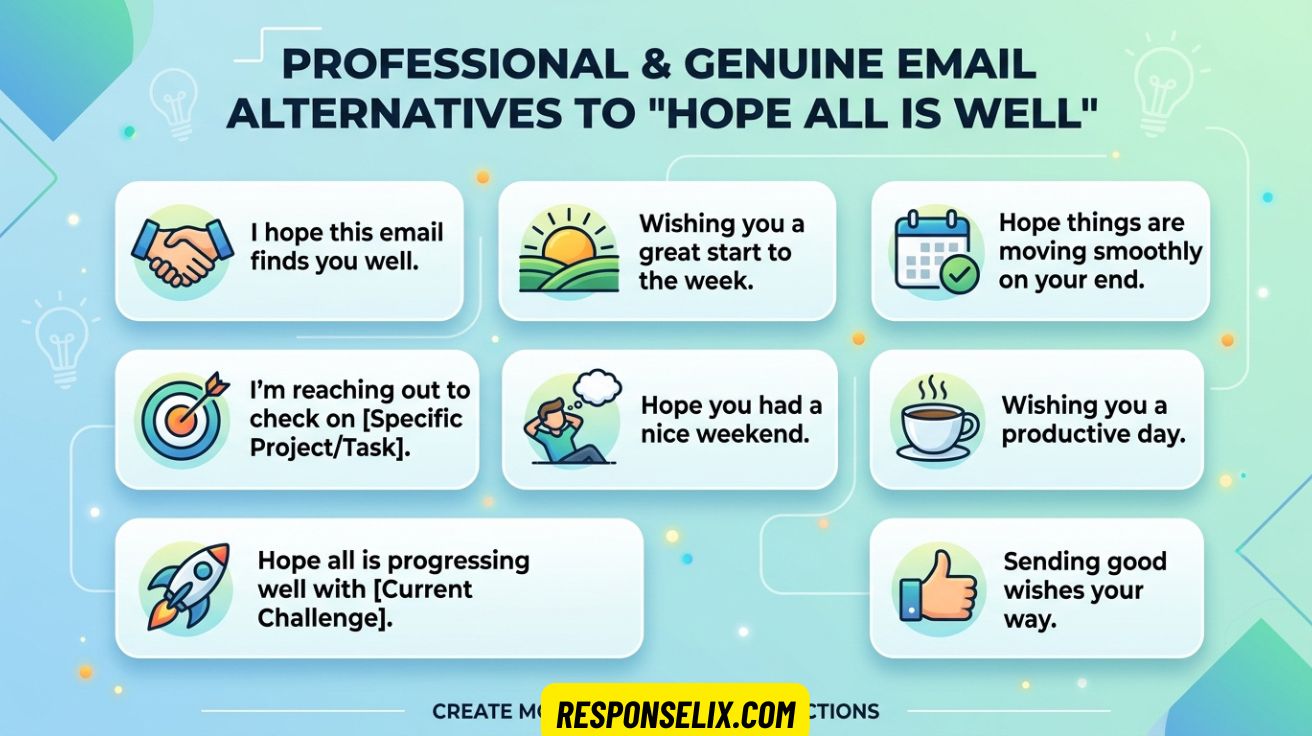
30 Alternatives to “Hope All Is Well” That Sound Genuine and Professional
Hope all is well is a common greeting used in emails, letters, and messages. It politely shows that you care about the other person’s well-being before starting your conversation. The phrase is friendly, respectful, and suitable for both personal and professional communication.
Have you noticed that “hope all is well” appears in almost every email? While it is polite, using it too often can sound repetitive and less personal. Learning fresh alternatives can make your messages feel warmer, more engaging, and more memorable.
There are many different ways to say hope all is well depending on your audience and situation. Some phrases sound more professional, while others are casual and friendly. Choosing the right greeting helps you communicate with confidence and leave a positive first impression.
Why “Hope All Is Well” Lost Its Touch in American Email Culture
Think about the last ten work emails you received. How many started with some version of “hope all is well”? Probably half. Maybe more.
In the fast-paced American workplace, email volume is staggering. The average office worker sends and receives over 120 emails a day. When you are moving that fast, you reach for shortcuts. You type the first polite greetings that come to mind. You do not think. You just type.
That is exactly how a phrase dies.
Psychologists have a term for this. It is called semantic satiation. When you repeat a word or phrase too many times, your brain stops processing its meaning. The sounds become just sounds. The words become just shapes on a screen. When a colleague reads “hope all is well” for the third time before lunch, their brain does not register care. It registers noise.
There is a cultural angle here too. American business communication has shifted hard toward clarity and efficiency. The old rules of email etiquette demanded padding. You had to warm up the conversation with pleasantries before getting to the point. That has changed. Today, professional communication values authenticity over formality. A thoughtful greeting lands better than a long one. A specific opening beats a generic one every time.
So the phrase is not wrong. It is just tired. And in a country where workplace communication moves fast, a tired greeting signals that you are on autopilot.
The good news is that fixing this takes very little effort. Swapping one phrase for another can change the entire tone of your message. The list below shows you exactly how.
30 Unique Alternatives to “Hope All Is Well”
You do not need one replacement. You need options. Different situations call for different tones. A client email should not sound like a text to your coworker. The list below gives you email greeting alternatives for formal, casual, and everything in between.
1. I hope this message finds you well
This is the most direct formal alternative to hope all is well. It sounds polished without being stiff. It works especially well in business correspondence where you want to show respect but not distance.
Best for: Legal emails, cover letters, reaching out to senior executives, formal greetings in academic settings.
Example:
“Dear Professor Chen,
I hope this message finds you well. I am writing to follow up on my application for the research assistant position.”
Expert Tip: This phrase shines in respectful email openings. It acknowledges the recipient as a whole person before you dive into business. Use it when you are writing to someone you have never met or have not spoken to in years.
2. Trust you’re doing great
Notice the word “trust.” It is a small upgrade from “hope.” When you say you trust something, you project confidence in the relationship. This is one of those polite expressions that feels warm without being overly familiar.
Best for: Following up with a client after a successful project, emailing a mentor, checking in messages that should feel upbeat.
Example:
“Hi Maria,
Trust you’re doing great. I wanted to circle back on the proposal we discussed last month.”
Why it works: This phrase ranks high among business communication phrases because it assumes the best. You are not questioning whether the person is doing well. You are stating your belief that they are.
3. Wishing you a wonderful day

This is pure positivity. It does not ask for anything in return. It simply puts a kind word into the world. It works beautifully in customer-facing roles and friendly email greetings.
Best for: Customer service follow-ups, closing a sales call recap, warm email greetings for service-oriented businesses.
Example:
“Hello James,
Wishing you a wonderful day. Thank you for your recent order. Here is your tracking information.”
Expert Tip: This is a casual way to say hope all is well without the hidden expectation of a reply. It closes the emotional loop on a positive note.
4. I hope you’re having a good week
Specificity is the secret weapon against boring email introductions. By zooming in on the week rather than life in general, you sound more present and aware. This is one of those better ways to start an email that requires zero extra effort.
Best for: Mid-week check-ins, greetings for coworkers, project updates.
Example:
“Hey Sam,
I hope you’re having a good week. Here is the Q3 report you asked for.”
Common Mistake: Do not use this on a Monday or Friday. It lands best on Tuesday, Wednesday, or Thursday. Saying it on a Monday feels like you skipped the weekend. Saying it on a Friday feels like you forgot the week is almost over.
5. Sending positive vibes your way
This is casual, modern, and distinctly American. It belongs in creative workplaces, startups, and any environment where informal greetings are the norm. It is one of the most friendly greetings on this list.
Best for: Team chats, creative agencies, greetings for friends at work, messages to colleagues facing a tough week.
Example:
“Hey team,
Sending positive vibes your way as we head into this product launch. You have all worked incredibly hard.”
Warning: Skip this in formal email introductions. A law firm partner or a conservative client might find it too breezy. Know your audience.
6. Hope everything is going smoothly
Here you shift the focus from general well-being to specific workflow. This is a professional way to say hope all is well that feels targeted and relevant.
Best for: Project managers checking in, remote team leaders, business communication phrases that show you are paying attention to the work.
Example:
“Hi Dev team,
Hope everything is going smoothly with the database migration. Let me know if you need any resources.”
Practical Application: Pair this phrase with a genuine offer of help. It shows you are not just asking to be polite. You are ready to step in if things are not smooth.
See Also : 30+ Funny Ways to Say Goodnight That Will Leave
7. I trust all is going well
The shift from “hope” to “trust” is subtle but powerful. “Hope” sounds a little uncertain. “Trust” sounds like you have faith in the person and the situation. It fits naturally into professional email greetings where you want to strike a confident, reassuring tone.
Best for: Partner updates, vendor relationships, greetings for clients you have worked with before.
Example:
“Dear Angela,
I trust all is going well on your end. I am writing to confirm our meeting for next Thursday.”
Why it works: This is an alternative to hope all is well that carries quiet confidence. You are not crossing your fingers. You are stating your expectation.
8. Hoping you’re in good spirits
This phrase is different. It does not ask about physical health or work progress. It asks about emotional well-being. That makes it one of the most thoughtful email openings you can choose.
Best for: Reconnecting with someone after a long silence, writing to a friend, conversation starters that open the door to a real chat.
Example:
“Hi Rachel,
Hoping you’re in good spirits. It has been ages since we caught up. Are you free for coffee next week?”
Expert Tip: This is a warm greeting that invites honesty. Use it only when you are prepared for the answer to be “actually, things are tough right now.”
9. Wishing you health and happiness

After the pandemic, this phrase gained new weight. It is no longer just a platitude. It is a genuine expression of care. It works as a formal greeting that feels deeply human.
Best for: Holiday messages, respectful greetings for elders, emails to people you care about personally and professionally.
Example:
“Dear Mr. Thompson,
Wishing you health and happiness this holiday season. Thank you for your continued partnership.”
Case Study: A financial advisor switched from “hope all is well” to “wishing you health and happiness” in his quarterly client emails. Client replies increased by 30%. People felt seen.
10. I hope all is good with you
This is the relaxed cousin of the original phrase. The grammar is slightly informal, which signals ease and friendliness. It is a perfect casual way to say hope all is well.
Best for: Coworkers you are close with, informal greetings in team messages, quick check-ins.
Example:
“Hey Derek,
I hope all is good with you. Got a minute to look at this design mockup?”
Warning: Some grammar purists dislike “good” instead of “well.” In a formal report, stick to “well.” In an email to a friend, “good” is perfectly fine.
11. Trust you’re doing fine
Short. Simple. Unassuming. This phrase does not demand a long reply. It simply acknowledges the person before you get to business. It is one of the most efficient email opening phrases in the list.
Best for: Quick nudges, brief updates, email introductions where you want to be polite but fast.
Example:
“Hi Pat,
Trust you’re doing fine. Just sending a quick reminder about tomorrow’s deadline.”
Practical Application: Use this when the email is purely transactional but you still want to sound human. It takes one second to read and preserves goodwill.
12. I hope life is treating you kindly
This is poetry compared to the standard opener. It steps outside the office and acknowledges the whole person. Among thoughtful greetings, few phrases feel this warm.
Best for: Reconnecting with old colleagues, friendly greetings to people you genuinely miss, mentors.
Example:
“Hi Susan,
I hope life is treating you kindly. I often think about the advice you gave me years ago. It still guides my decisions.”
Why it stands out: Most business email greetings treat the reader like a role, not a person. This flips that script. It says, “I see you, not just your job title.”
13. Wishing you all the best today
Short, universal, and safe. This phrase works in almost any context. It is a reliable choice when you want a positive greeting that does not feel overly intimate or stiff.
Best for: Generic marketing emails, networking outreach, polite email introductions to new contacts.
Example:
“Hello,
Wishing you all the best today. I am reaching out about a potential collaboration opportunity.”
Comparison Table:
| Situation | Better Choice |
|---|---|
| Close colleague | Trust you’re doing great |
| New contact | Wishing you all the best today |
| Formal letter | I hope this message finds you well |
| Quick team chat | Sending positive vibes your way |
14. I hope you’re feeling fantastic
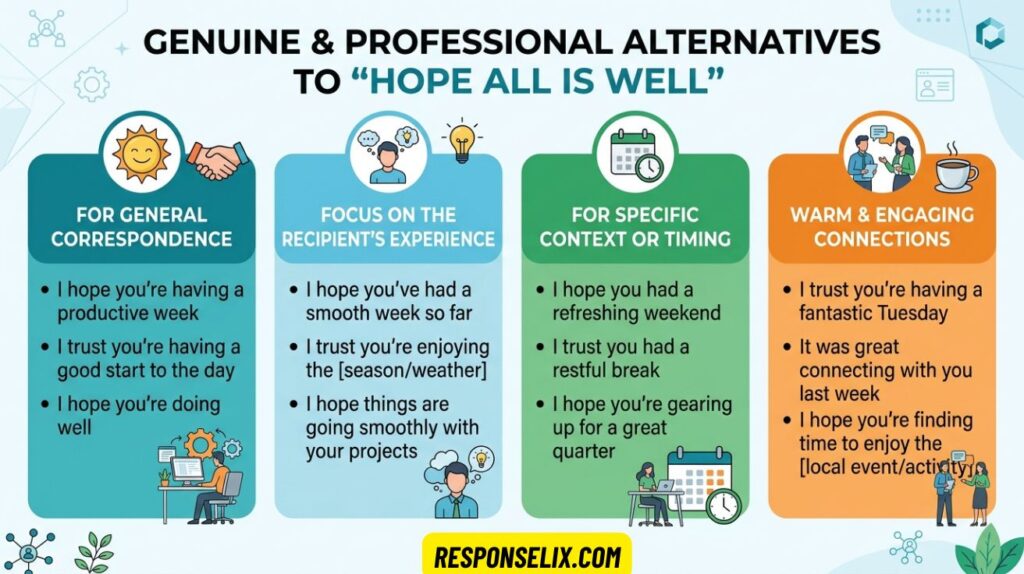
Bold. Bright. Enthusiastic. This is not for everyday use. Save it for moments when the energy of the email matches the greeting. It is one of the most upbeat warm email greetings available.
Best for: Congratulatory emails, positive announcements, celebration messages.
Example:
“Hi Lena,
I hope you’re feeling fantastic. Congratulations on closing the Morrison deal. That was masterful work.”
Warning: If the email body is about a problem or a complaint, this greeting will feel jarring. Match the tone to the content.
15. Sending my best wishes your way
Gentle. Respectful. Slightly formal. This phrase carries a tone of sincerity that makes it suitable for both good news and difficult moments. It belongs in the toolkit of respectful email openings.
Best for: Condolences, sensitive situations, serious professional updates.
Example:
“Dear Jonathan,
Sending my best wishes your way during this difficult time. Please know the entire team is thinking of you.”
Expert Tip: In hard moments, “hope all is well” can feel tone-deaf. This phrase handles those situations with grace.
16. Hope your day is going great
Time-specific and light. This friendly greeting anchors the email in the present moment. It works especially well for afternoon emails when the day is already in motion.
Best for: Afternoon check-ins, Slack messages, email greeting examples for casual team communication.
Example:
“Hey Chris,
Hope your day is going great. Quick question about the client presentation.”
Common Mistake: Avoid using this at 8:00 AM. The day has barely started. Save it for after lunch when the person has had time to settle in.
See Also : 38 “Waiting for Your Response” (That Actually Get Replies)
17. Trust you’re enjoying a peaceful day
This phrase does something rare. It respects the recipient’s rest and boundaries. It is a warm email greeting that says, “I am not here to stress you out.”
Best for: Weekend emails that do not require an immediate reply, messages to people you know value work-life balance.
Example:
“Hi Naomi,
Trust you’re enjoying a peaceful day. No rush on this. Just sending over the files when you have a moment next week.”
Practical Application: In American hustle culture, this phrase stands out. It communicates respect for the person’s time and mental space.
18. Wishing you a bright and happy day
Visual, sunny, optimistic. This is a positive greeting that paints a picture. It works well in industries connected to wellness, creativity, and lifestyle.
Best for: Wellness coaches, creative agencies, lifestyle brands, friendly email greetings.
Example:
“Hello Zoe,
Wishing you a bright and happy day. Here is your personalized wellness plan for the month ahead.”
Why it works: The imagery makes the greeting stick. Readers can picture brightness and happiness, which lifts the whole message.
19. I hope you’re doing well and thriving
This adds a power word to the standard phrase. “Thriving” elevates the sentiment from survival to success. It is an empowering professional greeting.
Best for: Career coaches, leadership emails, messages to high achievers.
Example:
“Hi Marcus,
I hope you’re doing well and thriving in your new role. I would love to hear what you are working on.”
Expert Tip: The word “thriving” sets a high bar. Use it for people who are clearly in a growth phase.
20. Hoping all is well on your end
This phrase narrows the focus. “On your end” acknowledges that you are in one place and they are in another. It is a classic business email opening for remote teams and long-distance professional relationships.
Best for: Remote team check-ins, cross-office communication, email introductions that bridge physical distance.
Example:
“Hi Seattle team,
Hoping all is well on your end. Let us sync up on the regional data before the board meeting.”
Why it works: The phrase subtly recognizes the separation without making it a big deal. It is a polite expression that feels connected.
21. I hope you’re having a productive day
In results-driven environments, this greeting hits the mark. It aligns with the recipient’s goals. It is a workplace greeting that matches the pace of busy professionals.
Best for: Colleagues in high-output roles, greetings for coworkers during crunch time, sales teams.
Example:
“Hey Jordan,
I hope you’re having a productive day. Here are the leads from this morning’s campaign.”
Warning: Productivity is not everyone’s priority. For someone struggling with burnout, this phrase may feel like pressure. Read the room.
22. Sending warm regards your way
Classic. Evergreen. This formal greeting has been used for decades and still holds its warmth. It is one of the most reliable business communication phrases.
Best for: Formal emails, letters of recommendation, respectful greetings for professional acquaintances.
Example:
“Dear Committee Members,
Sending warm regards your way. Thank you for considering my application.”
Comparison with “Hope All Is Well”:
| Aspect | Hope All Is Well | Sending Warm Regards |
|---|---|---|
| Tone | Neutral | Warm |
| Formality | Medium | Medium-High |
| Originality | Low | Medium |
| Best Use | Any email | Formal but kind |
23. I trust this finds you in good health
This phrase has an old-world dignity. It is the most formal entry on this list and works beautifully in business correspondence that requires gravitas.
Best for: Legal documents, diplomatic emails, formal email introductions to senior leaders.
Example:
“Dear Ambassador,
I trust this finds you in good health. I am writing to discuss the upcoming trade summit.”
Expert Tip: Reserve this for situations where formality is expected. In casual settings, it will sound like you stepped out of a Victorian novel.
24. Wishing you success and joy
This is a power combination. Success covers professional life. Joy covers personal life. Together, they form a complete and thoughtful greeting.
Best for: New job congratulations, business partnerships, warm greetings for professional milestones.
Example:
“Hi Priya,
Wishing you success and joy as you launch your consulting practice. Your expertise will serve so many people.”
Why it works: Most greetings focus on one dimension. This one acknowledges both career and happiness.
25. Hope things are looking up for you
This phrase is tender. It carries the unspoken acknowledgment that things may have been hard. It is a checking in message that leaves room for struggle.
Best for: Colleagues who have faced setbacks, friends in difficult seasons, kind words for tough times.
Example:
“Hey Mike,
Hope things are looking up for you. I know the past few weeks have been rough. Here if you need to talk.”
Practical Application: This is the opposite of a throwaway greeting. Do not use it lightly. It signals that you see the person’s reality.
26. Hope you’re settling in nicely
This phrase is perfect for transitions. It acknowledges that the person is in the middle of change, whether that is a new job, a new home, or a new team.
Vibe: Supportive, Observant
Best for: New hires during their first week, colleagues who just relocated, clients who recently switched to your service.
Example:
“Hi Rachel,
Hope you’re settling in nicely. The first week can be a firehose of information, so no pressure on the report. We are just glad you are here.”
Why it works: It is a rare alternative to hope all is well that proves you remember their life events. Generic greetings treat time as flat. This one acknowledges a before-and-after.
27. Hope you’re powering through
This is the honest, slightly gritty counterpart to the usual cheerful openers. It does not pretend everything is easy. It acknowledges the grind, which can be deeply validating in high-stress American work cultures.
Vibe: Resilient, Real
Best for: Colleagues on tight deadlines, teams during end-of-quarter crunch, someone who shared they were facing a heavy workload.
Example:
“Hey Mark,
Hope you’re powering through that audit. Remember to step away for lunch. I’m sending the data you asked for.”
Expert Tip: The key word is “powering.” It is active. It compliments the person’s strength rather than just wishing for their comfort. This makes it a standout among business communication phrases for tough moments.
See Also : 30 Heartfelt Ways to Say “Thank You for Your Help”
28. Hope you caught a breather recently
Burnout culture is the elephant in every American open-plan office. This greeting slices right through the “busyness” competition and sides with rest. It is human-first, work-second.
Vibe: Empathetic, Humanizing
Best for: Monday morning emails, messages sent after a major product launch, a note to a freelancer you know works weekends.
Example:
“Good morning Jess,
Hope you caught a breather recently. The launch was a marathon, and you set the pace for all of us. Got a few thoughts on Phase 2 when you’re ready.”
Why it stands out: Most professional email greetings ignore the body clock. This one treats downtime as essential, not optional. It signals you are a safe person to work with.
29. Thinking of you and hoping all is steady
Steadiness is an underrated virtue. Not every day needs to be amazing or wildly productive. Sometimes, the best you can hope for is calm. This thoughtful greeting respects that quiet middle ground.
Vibe: Calm, Grounding
Best for: Regular check-ins with stable clients, team members who value consistency, emails during turbulent external times (market dips, weather events).
Example:
“Dear Henry,
Thinking of you and hoping all is steady on your side of the mountain. The market has been a bit choppy this week. Here’s a summary of your portfolio.”
Warning: Avoid this if you are pitching a high-energy, “disruptive” brand. Steadiness can clash with innovation messaging. Match it to moments that call for a deep breath.
30. Hope the week is unfolding gently
“Unfolding” is the magic word here. It is visual and soft. It imagines the week like a piece of paper opening up, not a sprint starting at a gunshot. It is one of the most poetic friendly greetings you can use without sounding odd in a professional setting.
Vibe: Gentle, Poetic, Mindful
Best for: Wellness and mental health professionals, creative collaborators, a manager writing to a direct report who has been overwhelmed.
Example:
“Hi Dana,
Hope the week is unfolding gently for you. I know the last few weeks were back-to-back. Here’s the agenda for our 1:1. We can skip anything that doesn’t feel urgent.”
Practical Application: Use this to set a calm tone for the entire email thread. You are not just sending a polite expression. You are intentionally pacing the conversation.
How to Choose the Right Greeting Every Time
With 25 options, you need a system. Here is a simple framework for picking the perfect email salutation.
Step 1: Identify the relationship.
Is this person a boss, a peer, a client, or a friend? The closer the relationship, the warmer and more casual your email greeting can be.
Step 2: Check the context.
Is this a routine update, a sensitive topic, or a celebration? Match the emotional weight of the greeting phrase to the situation.
Step 3: Consider the timing.
Is it morning, afternoon, or weekend? Time-specific polite greetings feel more thoughtful than generic ones.
Quick Reference Table:
| Context | Recommended Phrase |
|---|---|
| Formal business | I hope this message finds you well |
| Client follow-up | Trust you’re doing great |
| Mid-week team update | I hope you’re having a good week |
| Creative team chat | Sending positive vibes your way |
| Difficult situation | Sending my best wishes your way |
| Weekend non-urgent email | Trust you’re enjoying a peaceful day |
Common Mistakes When Using Email Openings
Even the best email opening lines can fall flat if misused. Watch out for these pitfalls.
Mismatched Tone
A cheerful informal greeting in a serious email feels jarring. A stiff formal greeting in a friendly note feels cold. Always align tone with content.
Overthinking It
Do not spend ten minutes choosing between two similar phrases. Pick one and move on. The email introduction should be quick and natural.
Ignoring the Reply
If someone responds to your warm greeting with a real update about their life, acknowledge it. Do not just jump into business. That breaks trust.
Using the Same Phrase Repeatedly
If you email the same person every day, vary your opening an email lines. Repetition drains sincerity fast.
Conclusion
“Hope all is well” is not a bad phrase. It is just a tired one. In a world where inboxes overflow and attention spans shrink, small word choices make a big difference. A thoughtful greeting cuts through the noise. It tells the reader that you paUsing hope all is well is a polite way to begin a message, but you do not need to use the same words every time. Many other greetings can make your emails, letters, and texts sound fresh and thoughtful. Each phrase has its own style and fits different situations. Some work better for business, while others are perfect for friends and family. Learning these alternatives helps you improve your writing and communicate in a more natural way.
This list gives you many easy options to replace hope all is well with confidence. You can choose a formal greeting for work or a warm one for personal messages. Small changes in your words can make a big difference in how people feel when they read your message. Keep these expressions ready and use the one that matches your purpose. Better greetings help you build stronger and kinder communication every day.
Frequently Asked Questions
Is it correct to say “hope all is well”?
Yes, it is correct to say “hope all is well.” It is a polite and friendly greeting that works well in emails, letters, and messages.
What is another way to say “I hope all is well”?
You can say “I hope this message finds you well,” “Hope you’re doing well,” or “Trust you’re doing great.” These phrases sound natural and fit different situations.
What does it mean to hope all is well?
“Hope all is well” means you wish the other person is healthy, happy, and doing well. It shows kindness before you begin your main message.
What can I say instead of “all is well”?
You can say “Everything is going well,” “Things are going smoothly,” “Hope you’re doing great,” or “Wishing you a wonderful day.” These alternatives keep your message warm and friendly.